
Sunday, October 11, 2015
Earthworm
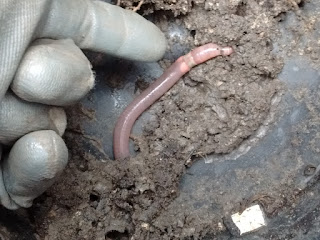
Back home, we have earthworms and we have nightcrawlers - the big ones. I haven't seen many nightcrawlers in Australia, but this one was living in the bottom of a potted agave plant.

Tuesday, September 29, 2015
Twenty-one items, one test
I applaud the government program to screen everyone in its health care system for bowel cancer. My first thoughts though... cancer - they give you toxic chemicals and cut things out of you, and it's still a long, painful death. Why bother? Once detected, why not just die quickly and avoid the prolonged suffering? And so my first question: "Is it curable?!" And the version of that question more people probably ask: "Should I bother doing this test??"
Unfortunately, NONE of the twenty-one items included in this thoughtful government-funded package answered that question quickly and concisely. I opened it immediately to see what it was, followed by a "Oh yeah. They sent a letter saying they were going to send this." So you might say that's twenty-three items, because I'm counting envelopes and postage as an expense. So I let it sit for about a week because I'm not that enthusiastic about trying to catch feces and put it into small tubes.
Finally, after about a week, I started sorting through the twenty-one items included in the package, looking for the directions, the crucial items, AND the answer to my question: "Why bother?!" I don't recall the cover letter really giving me much motivation - I did actually read it and couldn't tell you what it said. As I'm flipping through the material, I'm thinking maybe the little booklet has the answer - yes, the little booklet I was going to read some day. And because I'm familiar with large volumes of verbiage, I looked in the index of the booklet and there it was; EIGHTH item in the table of contents: Can bowel cancer be cured? I have to flip to page five to find the answer. And there it is - not in bold font - on front of the package exclaiming "WHY YOU SHOULD BOTHER!" but three quarters down the page in text that blends with everything else that basically reads "blah, blah, blah":
Bowel cancer is one of the most curable types of cancers if found early. That is why completing the free screening test sent to you is so important.
Oh. Why didn't you tell me that? I might have done the test right away, and someone else might have actually done the test, rather than leaving it on their counter for a year or so, thinking "Too much trouble. Why bother?"

Wednesday, September 23, 2015
Things about Australia that seem bizarre
This course costs $5200. It's called Captive Animals, Certificate III. This is the advanced certificate - ideally you'd have Certificate II before you spend an extra $5200 to get the Certificate III. Taking care of animals in cages. As someone who grew up in the country, it seems incredibly bizarre that you would not only have to get a certificate, you'd have to pay extra money to get the advanced certificate to do something like this. I could see getting some training - but $5200 worth? For a job like this? This is not even the level of a veterinary assistant - it's just cleaning cages; feeding animals?! Yeah, diseases, hygiene, blah, blah, blah - maybe a week of material? Nobody cleaning cages is going to remember all the potential pathenogenic agents - they'll just know a) get your shots and b) don't get bitten.
Thursday, September 10, 2015
Respect for Authoritarians
When your reputation is more important than the reality of who you are and what's really happening... Australian private schools seem to have a lot in common with the Catholic Church.
http://www.smh.com.au/national/education/royal-commission-cranbrook-headmaster-knew-about-child-sex-abuse-allegations-20150909-gjia4h.html
Thursday, August 20, 2015
Fauna
Something about this sentence delights me: Considering that the entire Australian fauna seems to have gone to school on the short bus, even Neanderthal-class hunters would have caused a mass extinction. Denisovians in Wallacea?
Sunday, August 2, 2015
Tracking citizens
The US and Australia have a very different approach to identity and citizen tracking. In some ways, the system in the US promotes the activities it supposedly prevents.
In Australia, you have to verify your identity to obtain a cell phone number. The government isn't specifically tracking people, but requires telecommunications companies to retain two years of data, in case law enforcement does need the data. And of course with national health care, the government has access to everyone's health information - even addresses are linked to identity in this system.
In the US, on the other hand, because people are paranoid about the government tracking people, there is a paranoia about identity cards, databases, and the government being able to follow people. Anyone can get a cell phone number using whatever name they like. There are many different databases (most have been hacked by now). The social security number is used as a de facto national identity (making identity theft an amateur occupation). Health information has for the past 10+ years been used to deny people insurance coverage (new laws prohibit this, but everyone is still wary). And of course, we all know that in the absence of other means, the government has developed methods for recording every phone conversation.
And I'm wondering - have Australia's databases not been hacked (except by Rupert Murdoch), or have they just managed to not get the breaches in the news?
Sunday, July 12, 2015
Have things changed?
I'd like to tag the guy in the tall hat with the names of a couple of Australian politicians, as well as a handful of people I've met who are associated with the university.

Subscribe to:
Posts (Atom)